How Does A Man Overboard Training Dummy Contribute to Safety Awareness?
In the maritime industry, we acknowledge that reading a rescue procedure is vastly different from executing it under pressure, in darkness, with the vessel rolling beneath our feet. Man Overboard Training Dummy solutions are crucial in closing the gap between theory and actual response. At SeaOnBag, based in the United Arab Emirates, we offer life-sized, weighted recovery simulators since we understand that real preparedness comes from repetition, not just theory.
Why Realism in Rescue Drills Changes Everything?
The Psychological Gap Between a Buoy and a Body
Many ships have practiced their MOB drills for years by tossing a light buoy overboard and timing how long it takes to retrieve it. This approach made sense, but actually made the crew less prepared, and that lack of readiness only becomes clear when a real person is in the water.
A lightweight float offers very little resistance. It does not move as a limp body does in the swell. It does not get stuck in a recovery cradle or drag on a net. When crew members only use these kinds of substitutes in practice, their brains learn the wrong way to do things. They learn how to get something back, not a person.
The psychological effect of using a realistic, weighted Man Overboard Training Dummy is evident in how crews act at the rail. You can see a change from casual execution to focused intensity. The weight signals that something needs to be done right away. The shape needs to be placed very carefully. Every deckhand knows that a real rescue will not be easy because of the physical work required and the responsibility that comes with it.
From Theoretical Knowledge to Muscle Memory
Adding a life-sized dummy to a drill does not just make it harder; it also makes it more realistic. We are changing the crew’s response pathway at the level of the brain. At first, it is a deliberate, step-by-step process: finding the victim, marking the spot, sending in the fast rescue craft (FRC), getting closer, and securing. Over time, it becomes automatic.
This automation under stress is what keeps people alive. When adrenaline kicks in and time seems to speed up, the body goes back to what it has practiced over and over. A crew that has pulled a 55 kg deadweight figure out of the water a dozen times will be much more accurate than one that has only read about how to do it in a manual.
Physical Characteristics of the SeaOnBag Dummy and Their Operational Value
Weight Distribution and Water Absorption
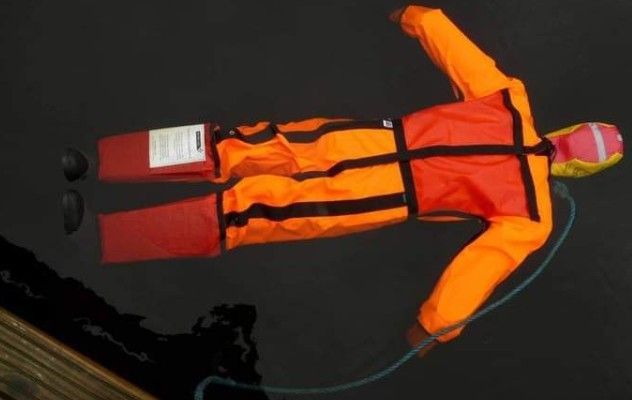
The SeaOnBag Fibrelight BOB Man Overboard Training Dummy is built around one main idea: it has to act like a person who is hurt and can not move. You can fill its internal bladder with water to make it weigh about 55 kg, which is a realistic weight. This number is not random; it is the lower end of what an average adult in full gear would weigh.
This water-filling mechanism offers several distinct operational advantages:
- Scalable difficulty: Drill supervisors can partially fill the bladder to adjust the challenge level for junior crew or increase it to maximum weight for senior rescue team assessments.
- True drag simulation: A water-filled body exerts real lateral resistance against nets, cradles, and slings, forcing crews to adjust technique, not just apply force.
- Realistic thermal behavior: Unlike foam, water-filled materials respond to movement in ways that mimic the inertia of a human torso, making positioning during recovery far more instructive.
Flotation Orientation and Its Drill Impact
The buoyancy profile is one of the most important technical aspects of the dummy. It is designed to float with the head up, like a person wearing a regular life jacket or immersion suit. This is very important during FRC approach drills.
Crews learn to:
- Position the rescue craft so that the propellers clear the casualty's legs
- Approach from the downwind side to prevent the vessel from drifting over the figure
- Use the cradle at the correct angle relative to a vertically floating body
None of these critical approach skills can be practiced accurately with a horizontal floating object. The dummy's orientation is not cosmetic; it is operationally essential.
Durability in Harsh Maritime Environments
We know a lot about what the sun, salt, and heat do to bad materials because we work in the United Arab Emirates. The dummy is made of PU-coated polyester, which does not break down in UV light or saltwater. It does not get waterlogged, crack after being inflated many times, or lose its structural integrity after being exposed for a long time.
Because it lasts so long, we can do drills every day without having to pay for new ones all the time. When equipment lasts, training programs stay the same, and consistency is what real readiness is built on.
Identifying Gaps in Shipboard Emergency Procedures
What Repetition Reveals?
The value of a quality Man Overboard Training Dummy does not end after the first successful drill. In fact, the most instructive moments often occur during the fifth, sixth, or seventh repetition, when the novelty has worn off, and procedural weaknesses begin to surface.
We have observed that repeated drills with a realistic dummy expose several categories of procedural gaps:
- Communication breakdowns: Who calls the bridge? Who manages the deck crew? Confusion about these roles becomes evident when the pressure of managing a heavy recovery load is introduced.
- Equipment positioning failures: Recovery cradles stored in the wrong location, lines that tangle under load, and davit release mechanisms that have not been serviced all appear during practice, not during real emergencies.
- Crew fitness mismatches: A drill reveals whether the assigned recovery team is physically capable of executing the procedure. If it does not, reassignments can be made before lives depend on the outcome.
Each gap identified during a drill is a life-safety finding. Logging these findings and tracking their resolution creates a documented improvement cycle that no annual audit can substitute.
The Immersion Suit Integration Challenge
A complete rescue drill must also account for the added complexity of casualty gear. When a person enters the water wearing an Immersion Suit, their body profile changes; they are bulkier, more buoyant, and harder to grip. Practicing recovery with a dummy dressed in equivalent equipment prepares crews for the real physical mechanics of this scenario.
SeaOnBag's dummy, with its realistic proportions, allows for the attachment of trial immersion suits or flotation gear, making integration drills possible in a controlled environment. This level of scenario fidelity is simply not achievable with a basic ring buoy.
Setting a Higher Standard for Maritime Safety in the UAE
Why Can’t Vessel Operators Afford to Settle?
The maritime regulations that apply to vessels operating out of the United Arab Emirates set minimum standards for onboard safety equipment and drill frequency. But we at SeaOnBag are committed to a standard that exceeds the minimum, because the sea does not grade on a curve.
When a crew member goes over the rail in a strong current, the factors that determine survival are response time, procedural accuracy, and physical capability. All three are products of training quality. A Man Overboard Training Dummy that weighs as much as a real person, floats as a real person, and resists recovery as a real person does is the only tool that prepares a crew for all three.
Building a Culture Where Every Drill Counts
The cultural dimension of realistic MOB training is often underestimated. When crews drill with proper equipment, they take the exercise seriously. When they see their colleagues struggle to haul a 55 kg figure over the rail, they understand what is at stake. That shared understanding changes how people approach their roles aboard the vessel, not just during drills but during every watch.
At SeaOnBag, we supply the tools that make this cultural shift possible. From the Man Overboard Training Dummy to recovery cradles and complete life-saving appliances, our product range is built around a single commitment: giving maritime crews in the United Arab Emirates and beyond what they need to bring every person home safely.
FAQ
1. Why is a Man Overboard Training Dummy better than using a buoy during drills?
A standard buoy does not replicate the weight, drag, or movement of a real person in the water. A Man Overboard Training Dummy provides crews with more realistic recovery practice, helping them build practical rescue skills under conditions closer to an actual emergency.
2. How much does the SeaOnBag Man Overboard Training Dummy weigh?
The SeaOnBag Fibrelight BOB dummy can be filled with water to reach approximately 55 kg. This realistic weight helps simulate the physical effort required during an actual man overboard recovery operation.
3. Can the training dummy be used with immersion suits during drills?
Yes. The dummy’s realistic body proportions allow crews to conduct rescue drills using immersion suits and other flotation equipment. This helps teams practice handling bulkier casualties during recovery scenarios.
4. What operational issues can realistic MOB drills reveal?
Repeated drills with a weighted dummy can expose communication problems, poor equipment placement, recovery technique weaknesses, and physical limitations within the rescue team. Identifying these issues during training helps crews improve procedures before real emergencies occur.
5. Why is durability important for maritime training equipment?
Maritime rescue equipment is constantly exposed to UV radiation, saltwater, humidity, and harsh weather. Durable materials help training equipment maintain consistent performance during repeated drills, supporting long-term safety preparation for vessel crews.